Why everybody kills the King
The Assassin goes first. You name a character, and whoever secretly picked it skips their whole turn. The catch is that you have to guess who is in play, and the King is the safest guess there is. He can never be one of the cards discarded face up at the start of a round, and he hands out the crown, so plenty of players want him.
Our numbers agree with the reflex. At the moment a four-player Assassin chooses, an opponent holds the King 71% of the time. No character is in play more often; the Merchant ties. The Architect, by comparison, is in an opponent's hand 51% of the time.
A dead King still gets the crown
Here is the part people forget. A murdered King skips his turn, but at the end of the round he reveals his card and takes the crown anyway, as the King's heir. He still picks first next round. All your kill takes away is one turn.
So what is a turn worth? We counted what each character gained per turn in 18,000 four-player games. The King's turn is ordinary: 2.5 gold, about what the Bishop and the Warlord collect. The Merchant's is the richest in the game at 3.7 gold, and the Architect draws two extra cards every time.
What one turn earns, by character
Average gold (taken, income and bonuses) and district cards gained per turn. Four players, 18,000 games. The Thief's take comes on top: 1.1 gold per Thief turn.
- Gold
- Cards
Show the numbers
| Character | Gold per turn | Cards per turn | Points built per turn | Turns counted |
|---|---|---|---|---|
| Assassin | 1.78 | 0.13 | 2.09 | 85,618 |
| Thief | 1.80 | 0.12 | 1.92 | 63,540 |
| Magician | 1.94 | 0.96 | 1.62 | 51,965 |
| King | 2.49 | 0.22 | 2.15 | 119,661 |
| Bishop | 2.45 | 0.26 | 2.32 | 61,489 |
| Merchant | 3.72 | 0.38 | 3.62 | 64,839 |
| Architect | 1.82 | 2.09 | 2.79 | 60,554 |
| Warlord | 2.41 | 0.25 | 2.51 | 69,946 |
What is a kill actually worth?
Counting gold only gets you so far. A kill also costs the victim a building, a power and sometimes the game. So we measured it directly. At 3,338 moments in real bot games, right when an Assassin had to name someone, we froze the game and replayed the rest of it four times for every possible target, with the same shuffles for every target. Then we compared each replay with the one where the Assassin killed nobody.
The result: when the kill lands, the King is the cheapest victim in the game, with both four and two players. With four players a dead Architect is worth +6.0 points of win chance to the Assassin, a dead Merchant +4.7, a dead King +1.9. With two players every kill matters more, and the King is still last at +12.4.
Win chance gained by a kill that lands
Percentage points for the Assassin's player, compared with killing nobody. Same game, same shuffles, only the target changes.
- 4 players
- 2 players
Show the numbers
| Target | 4 players | 4 players, victim is the leader | 2 players | In play (4p) | In play (2p) |
|---|---|---|---|---|---|
| Thief | +2.3 | +3.0 | +16.3 | 58% | 20% |
| Magician | +3.0 | +3.7 | +15.3 | 39% | 30% |
| King | +1.9 | +1.9 | +12.4 | 71% | 37% |
| Bishop | +4.2 | +10.9 | +18.9 | 55% | 35% |
| Merchant | +4.7 | +7.6 | +22.2 | 71% | 42% |
| Architect | +6.0 | +5.4 | +23.2 | 51% | 40% |
| Warlord | +2.8 | +6.9 | +22.8 | 69% | 31% |
Two details in the table are worth a second look. First, who you hit matters as much as what you hit: killing the Bishop is worth +10.9 when the leader is holding it, because the Bishop is the leader's shield against the Warlord. Second, a miss costs almost nothing. Naming a character nobody picked is barely worse than not killing at all, so there is no reason to play it safe with the King.
Full games: who should your Assassin aim at?
One frozen moment is not a whole game, so we also played it out. In every game one seat got a fixed hit list and everyone else used the smart Assassin: a bot that works out from the draft who probably holds what, and aims at the turn that hurts most, preferably the leader's. Seats and the crown rotate. With four players each policy played 18,000 games.
Win rate by Assassin policy, four players
Compared with a fair share of 25%. Margin of error about 0.6 points.
Show the numbers
| Assassin policy | Win rate | Kill lands | Games |
|---|---|---|---|
| Smart (reads the draft) | 24.7% | 83% | 18,000 |
| Always the Merchant | 24.7% | 77% | 18,000 |
| Always the Architect | 23.6% | 61% | 18,000 |
| Always the Warlord | 23.3% | 73% | 18,000 |
| Always the Bishop | 23.1% | 66% | 18,000 |
| Anyone, at random | 22.9% | 60% | 18,000 |
| Always the Magician | 22.8% | 55% | 18,000 |
| Always the Thief | 22.7% | 66% | 18,000 |
| Always the King | 22.5% | 71% | 18,000 |
| Never kills | 20.6% | - | 18,000 |
Always killing the King costs 2.2 points of win rate against the smart Assassin. That puts it in the bottom group with the Thief, the Magician and killing at random; only never killing is clearly worse. The Merchant is the best fixed target: 24.7%, as good as the smart bot, whose own favorite victim is the Merchant (37% of its kills).
The pattern holds at every table size we tried, and with the original eight-district ending too. It is loudest with two players, where every kill is a kill on your only opponent.
| 2 players | 4 players | 5 players | 4p, 8 districts | |
|---|---|---|---|---|
| Smart (reads the draft) | 50.3% | 24.7% | 19.6% | 25.5% |
| Always the Merchant | 44.1% | 24.7% | 20.0% | 24.2% |
| Always the King | 40.7% | 22.5% | 18.8% | 22.6% |
| Anyone, at random | 40.2% | 22.9% | 18.4% | 23.5% |
| Never kills | 33.8% | 20.6% | 17.1% | 20.7% |
Who to kill
- Default: the Merchant. Richest turn in the game, and almost always in play.
- Think the leader took the Bishop? Kill the Bishop. Kills on the leader are worth the most, and that one most of all (+10.9 points).
- The Architect is the biggest swing when it lands (+6.0), but it is in play less often. Worth it when the draft says it is out there.
- The King only if one player takes him every single time, and mostly in a two-player game.
- Always kill someone. A miss costs you almost nothing; never killing is the worst policy we tested.
Do it every game and your friends will notice
The obvious counter to a King-killer is to stop taking the King while they might hold the Assassin. So we gave the other bots that knowledge. When the King-killer picked before them and the Assassin was gone, they priced the King's turn as probably lost and took something else. They still took the King when the Assassin was safely out of the King-killer's hands, so the crown kept moving.
It works. With four players the King ends up with an opponent in 46% of rounds instead of 57%, the King-killer's hit rate falls from 71% to 46%, and its win rate from 23.2% to 21.8%. With two players it is brutal: hit rate 43% to 20%, win rate 41.0% to 33.8%. The smart Assassin barely notices the same opponents with four players (24.8%) and loses a little with two (48.1%), because it was never that predictable in the first place.
When the table knows your habit
Win rate above or below a fair share, in percentage points. 'Knowing' opponents avoid the King when the King-killer may hold the Assassin.
- King-killer, naive table
- King-killer, table knows
- Smart Assassin, table knows
Show the numbers
| Setup | 2 players | 4 players | 5 players |
|---|---|---|---|
| King-killer vs naive | 41.0% (kill lands 43%) | 23.2% (kill lands 71%) | 18.9% (kill lands 77%) |
| King-killer vs knowing | 33.8% (kill lands 20%) | 21.8% (kill lands 46%) | 17.2% (kill lands 56%) |
| Smart vs knowing | 48.1% (kill lands 74%) | 24.8% (kill lands 87%) | 19.4% (kill lands 90%) |
The exception: the friend who always takes the King
The old advice has one exception, and it is real. If someone at your table grabs the King whenever they see him, the King stops being a guess. We tested that too, with opponents who take the King every time it is offered.
With two players, killing the King every time then beats the smart Assassin: 73.2% against 71.0%. With four players it still doesn't (24.6% against 30.0%): a near-certain hit on the King is worth less than a likely hit on the Merchant, and two other players profit from your kill.
Two players: the Assassin is half the game
Citadels with two players is a different game. Each of you plays two characters, four of the eight are discarded face down, and the draft tells you a lot: by the time the Assassin acts, you know your opponent holds exactly one card from each of two pairs. That is why the smart Assassin lands 70% of its kills with two players, while a fixed target lands far less often (the King 43%).
It is also why the stakes are higher. Never using the Assassin drops you to 33.8%, and the best fixed target, the Merchant again, only reaches 44.1%. Reading the draft is worth more than any hit list. And every kill weighs more: a dead Merchant swings the game by +22.2 points with two players, against +4.7 with four.
Get the game
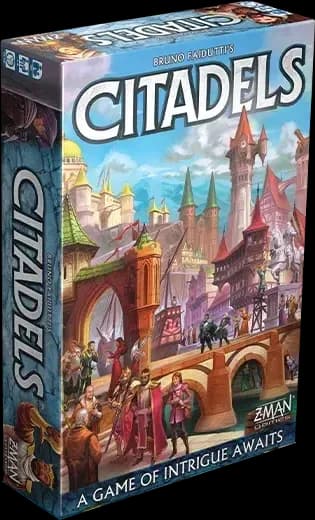
Everything here uses the original eight characters, which are in every Citadels box: Citadels Classic has just those eight, the current Citadels edition adds alternative characters for every rank. Both use the same seven-district ending with four or more players. If you mostly play as a couple: Citadels Duel, a separate two-player design, was listed for release in late October 2026. We have not simulated it (yet).
Looking for more games for two? Our best 2-player board games ranking includes Citadels with the two-player rules, next to games we have taken apart the same way.
How we tested
The rules engine covers the eight original characters and the base district deck: 54 basic districts plus the 12 purple districts of the original box, with their powers (Keep, Great Wall, Graveyard, Library, Observatory and the rest). Rules follow the current Citadels Classic rulebook: face-up discards by player count (never the King), the two-character draft for two players, the King's heir taking the crown, the Thief unable to rob the Assassin or the victim, the Warlord paying one less than the cost and never touching the Bishop or a completed city, and a city complete at seven districts (eight with two players). We also ran the original eight-district ending for four players. 840,000 full games, plus 87,744 replays for the kill-value experiment, with every odd rule checked by automated tests.
The bots draft by valuing each character for their own position (district income, gold, cards in hand, who is close to finishing) and discounting characters that are likely to be killed or robbed. They pick with some randomness, so they can't be read perfectly. The smart Assassin estimates who holds what from the cards passed during the draft, treating every consistent assignment as equally likely, and weights each target by what that player's turn is worth, with extra weight on the leader.
Limits worth knowing. Bluffing is the heart of Citadels and the hardest part to model: our bots don't talk, don't lie about their plans and don't read faces. A human who sells a fake Merchant pick can beat any of these numbers. The kill-value replays used four replays per target, so single numbers carry a margin of a point or so; the order of the targets held across player counts. The current Citadels box has some different purple districts than the original, which we did not model. And none of this is solved play: "smart" means the best Assassin of the ones we tested. More on how we test.
Image credits
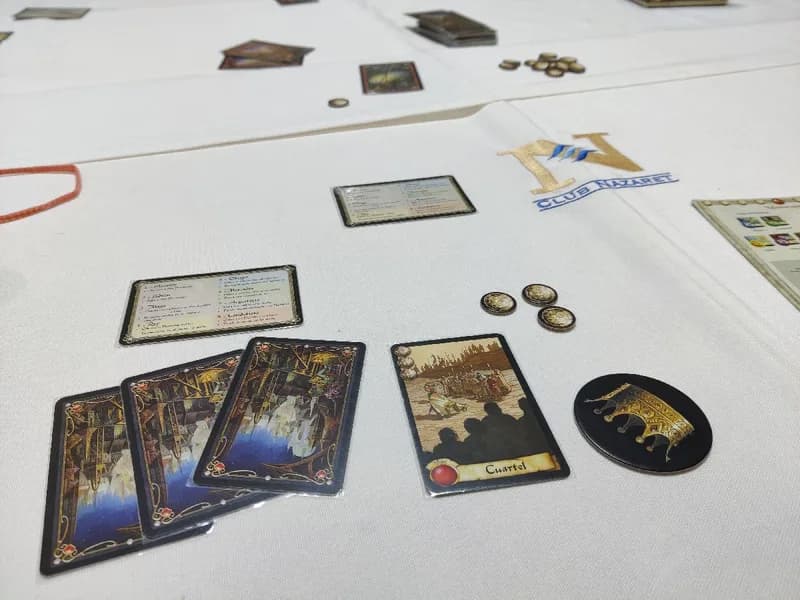
- Photo: El Pantera / Wikimedia Commons, CC BY-SA 4.0 (CC BY-SA 4.0, author El Pantera (https://creativecommons.org/licenses/by-sa/4.0)): Citadels cards and coins on the table during a game (Spanish edition)
- Box art: Z-Man Games (publisher image): Citadels box (current Z-Man edition), 3D view