First, what a dot is worth
The dots under a number token count the ways to roll that number with two dice. There are 36 ways in total, so a 6 with its five dots comes up 5 times in 36 rolls. Add up the dots around a spot and you know how many cards it pays per 36 rolls.
And it pays on every roll, not just yours. With four players a 6 next to your settlement pays out 5.6 times every ten rounds on average. A 2 pays out once every 9 rounds: about 2 times in a whole game of 20 rounds.
How often each number comes up
Two dice, 36 equally likely rolls. The dots on each token are its share of those 36.
Show the numbers
| Number | Ways (dots) | Chance per roll | Rolls between hits | Rounds between hits (4 players) | Tokens on the board |
|---|---|---|---|---|---|
| 2 | 1 | 2.8% | 36 | 9 | 1 |
| 3 | 2 | 5.6% | 18 | 4.5 | 2 |
| 4 | 3 | 8.3% | 12 | 3 | 2 |
| 5 | 4 | 11.1% | 9 | 2.3 | 2 |
| 6 | 5 | 13.9% | 7.2 | 1.8 | 2 |
| 7 | 6 | 16.7% | 6 | 1.5 | - |
| 8 | 5 | 13.9% | 7.2 | 1.8 | 2 |
| 9 | 4 | 11.1% | 9 | 2.3 | 2 |
| 10 | 3 | 8.3% | 12 | 3 | 2 |
| 11 | 2 | 5.6% | 18 | 4.5 | 2 |
| 12 | 1 | 2.8% | 36 | 9 | 1 |
6s and 8s, or every resource?
The oldest Catan argument. One side says take the best numbers and trade for the rest. The other says a resource you never roll is a resource you have to beg for.
We built six opening strategies on one shared bot (more on that below), so the only thing that differs is where they settle and what they value. The Pip chaser takes the most dots, period. Variety first takes as many different resources as it can. Balanced counts dots, gives extra credit for resources that are scarce on this board, for new resource types and for harbors. We sat each one at a table of three Balanced bots, rotated the seats and played 7,500 games per strategy, with simple trading between players switched on.
One opening strategy against three Balanced bots
Win rate compared to a fair share (one in four). Trading between players on.
Show the numbers
| Strategy | What it does | Vs fair share (trading) | Vs fair share (no trading) | Dots at the start | Resource types at the start |
|---|---|---|---|---|---|
| Ore and wheat | settles on ore and wheat, builds cities and buys development cards first | +14% | -14% | 19.7 | 3.4 |
| Balanced | high numbers, extra credit for scarce resources, new resource types and harbors | +1% | +3% | 19.8 | 4.6 |
| Variety first | as many different resources as possible, then dots | -7% | -10% | 19.3 | 4.8 |
| Pip chaser | the most dots, nothing else | -20% | -40% | 21.9 | 3.5 |
| Wood and brick | settles on wood and brick, builds roads and settlements first | -52% | -58% | 20.4 | 3.4 |
| Random spots | starts on two random legal spots, then plays like Balanced | -89% | -92% | 11.2 | 2.8 |
The Pip chaser does get the best numbers: 21.9 dots on its two starting settlements against 19.3 for Variety first. But it starts with 3.5 resource types against 4.8, and it wins -20% against a fair share. Without trading between players it is worse still: -40%. Variety first does better (-7%), and Balanced, which wants both, sits at a fair share against copies of itself. Starting on random spots, the baseline everyone should beat, comes in at -89%.
Same board, five first picks
Where each strategy puts its first settlement on one of our random boards. Hover a marker for the spot.
- P: Pip chaser
- V: Variety first
- O: Ore and wheat
- W: Wood and brick
- B: Balanced
Show the numbers
| Strategy | Dots | Resources |
|---|---|---|
| Pip chaser | 13 | brick, wheat |
| Variety first | 11 | wood, sheep, wheat |
| Ore and wheat | 11 | sheep, wheat, ore |
| Wood and brick | 11 | wood, brick, wheat |
| Balanced | 11 | wood, wheat, ore |
On this board the Pip chaser goes for the 13-dot spot on brick and wheat. Every other strategy settles for fewer dots and a third resource. In a draft between four Balanced bots on the same board, nobody takes that spot at all.
What one extra resource type is worth
To put a price on it, we let all four players start on random legal spots and play the same way afterwards: 60,000 starting positions, from hopeless to excellent. Then we compared positions with the same number of dots and a different number of resource types.
Starting dots and resource types against wins
All players start on random spots, then play the same way. Win rate compared to a fair share, trading on. Missing bars: too few positions of that kind.
- 2 types
- 3 types
- 4 types
- 5 types
Show the numbers
| Starting dots | 2 types | 3 types | 4 types | 5 types |
|---|---|---|---|---|
| 0-6 | -91% (3,150) | -87% (425) | - | - |
| 7-9 | -78% (5,325) | -62% (3,215) | -49% (355) | - |
| 10-12 | -54% (4,056) | -34% (7,549) | -9% (2,204) | - |
| 13-15 | -32% (2,329) | +5% (7,969) | +39% (4,279) | +84% (317) |
| 16-18 | -6% (788) | +46% (4,487) | +87% (4,208) | +121% (692) |
| 19+ | - | +106% (2,030) | +144% (3,232) | +185% (860) |
With 13 to 15 dots, players on two resource types come in at -32% against a fair share, players on four types at +39%. Three more dots with one type fewer comes out about even: 16 to 18 dots with three types (+46%) against 13 to 15 dots with four (+39%). A straight-line fit over all positions says one more type is worth 2 dots when players trade, and 3 when they don't.
Not every dot is equal either. In the same fit, measured in average dots, a dot of wheat is worth 1.3, ore 1, brick 1, sheep 0.9 and wood 0.8. A starting harbor was worth about 0.9 dots.
Ore and wheat, or wood and brick?
The second argument is about the whole plan. Wood and brick means roads and settlements: spread out early, grab Longest Road. Ore and wheat means cities and development cards: sit tight, upgrade, collect knights. We gave both plans the best shot we could: the opening strategy settles on its resources, the bot builds in its order, and we tried 12 settings for each plan before picking the best one for the main run.
Here is the race. Turns are your own turns, so turn 10 is the tenth time the dice come to you.
| Vs fair share | First city (median turn) | Ever builds a 5th settlement | Longest Road | Largest Army | Development cards bought | |
|---|---|---|---|---|---|---|
| Ore and wheat | +14% | turn 5 | 2% | 4% | 61% | 8.5 |
| Balanced | +1% | turn 10 | 30% | 43% | 32% | 5.1 |
| Variety first | -7% | turn 11 | 30% | 40% | 34% | 5.3 |
| Pip chaser | -20% | turn 11 | 23% | 33% | 40% | 6 |
| Wood and brick | -52% | turn 17 | 52% | 65% | 11% | 2.8 |
Who has a city by when
Share of players with at least one city by their own turn, one strategy against three Balanced bots.
- Ore and wheat
- Balanced
- Wood and brick
Show the numbers
| Own turn | Ore and wheat | Balanced | Wood and brick |
|---|---|---|---|
| 5 | 47% | 18% | 2% |
| 10 | 70% | 36% | 6% |
| 15 | 82% | 50% | 13% |
| 20 | 88% | 61% | 23% |
| 25 | 91% | 67% | 30% |
Wood and brick wins every race except the one that counts. It places a fifth settlement in 52% of its games and takes Longest Road in 65%. But with almost no ore its first city waits until turn 17, and once its settlement spots run out, everything that still scores needs ore. Ore and wheat has a city by turn 5, buys 8.5 development cards a game and takes Largest Army in 61% of games. Final score: +14% against -52%.
We tried to rescue wood and brick. The best of 12 play settings, re-run on 7,500 fresh games, is the -52% above. A milder opening that still likes good numbers and new resource types, with just a tilt toward wood and brick, came in at -26%. The best ore and wheat setting scored +25% in the smaller tuning run and +14% in the main one.
One level deeper: what if everyone goes ore and wheat?
A plan that wins against Balanced bots proves little if it only works because nobody else is doing it. There are three mountain hexes on the board. So we sat each strategy at tables where all three opponents play the same plan.
The best plan depends on the table
Win rate compared to a fair share for one player, at tables where all three opponents play one plan. Trading on.
- Balanced
- Ore and wheat
- Wood and brick
Show the numbers
| Strategy | At a table of pip chasers | At a table of ore and wheat players | At a table of wood and brick players |
|---|---|---|---|
| Balanced | +25% | +33% | +90% |
| Variety first | +20% | +30% | +76% |
| Pip chaser | +0% | +1% | +77% |
| Ore and wheat | +37% | +5% | +96% |
| Wood and brick | -43% | -6% | +3% |
At a table of Pip chasers, ore and wheat is the best plan we have (+37%). At a table of ore and wheat players it is just one more player fighting over three mountains, at +5%, while Balanced wins +33%. Even wood and brick climbs to -6% there. Trading matters too: without trades between players, ore and wheat drops to -14%, because it has to get its wood and brick from somewhere.
Does seat order matter, with the snake draft?
In the setup the first player places first, the last player places twice in a row, and the order snakes back: 1-2-3-4-4-3-2-1. The idea is that seat four makes up for the worst first pick with the best second one. In 30,000 drafts between identical Balanced bots, it doesn't quite: seat one's first settlement averages 11.7 dots and seat four's 10.1. Seat four gets the better second spot (9.3 against 8.5), but ends up 0.9 dots behind in total.
A snake draft between four Balanced bots
Numbers show the order of the eight starting settlements; colors are the four seats. Same board as above.
- Seat 1
- Seat 2
- Seat 3
- Seat 4
Show the numbers
| Pick | Seat | Dots | Resources |
|---|---|---|---|
| 1 | 1 | 11 | wood, wheat, ore |
| 2 | 2 | 11 | sheep, wheat, ore |
| 3 | 3 | 11 | wood, brick, wheat |
| 4 | 4 | 10 | wood, brick, sheep |
| 5 | 4 | 8 | sheep, wheat, ore |
| 6 | 3 | 9 | brick, sheep, ore |
| 7 | 2 | 11 | wood, sheep, wheat |
| 8 | 1 | 9 | brick, wheat |
Then the games. Between four identical Balanced bots, seat one wins 30% of the time and seat four 21%, against a fair 25%. With three players it is 38% against 30%. Using the price per dot from the random-openings test, the starting spots explain only about 33% of that gap. The rest is tempo: seat one rolls first, builds first and gets to every spot first for the whole game.
Wins by seat, identical bots
Win rate compared to a fair share, trading on.
- 3 players
- 4 players
Show the numbers
| Seat | 3 players | 4 players | 4 players, no trading | Starting dots (4 players) |
|---|---|---|---|---|
| 1 | +13% (38%) | +19% (30%) | +15% (29%) | 20.2 |
| 2 | -2% (33%) | +3% (26%) | +3% (26%) | 19.8 |
| 3 | -11% (30%) | -7% (23%) | -8% (23%) | 19.5 |
| 4 | - | -15% (21%) | -10% (22%) | 19.3 |
Are development cards worth it?
Counted as points, development cards are expensive. A card costs three resources, and only 5 of the 25 are worth a point.
| Cards | Points | Cards per point | Also gives you | |
|---|---|---|---|---|
| Settlement + 2 roads | 8 | 1 | 8 | production, and a spot nobody else can take |
| City | 5 | 1 | 5 | double production on that spot |
| Development card | 3 | 0.2 | 15 | a 56% chance of a knight, plus progress cards |
But that undercounts the knight. Say the robber sits on your 6. It costs you 5/36 of a card per roll, on every player's roll, so 0.6 cards per round in a four-player game. Left alone it stays until the next 7, which is 6 rolls away on average: about 0.8 cards per settlement on that hex. A knight gets that back, steals a card, and counts toward Largest Army, which is two points.
In our games that adds up. The ore and wheat bot buys 8.5 development cards per game, plays 4.1 knights, takes Largest Army in 61% of games, and is the plan that wins most. Development cards are not a way to score. They are a way to turn ore, wheat and sheep into points when your settlement spots run out.
How to play the opening
- Count dots, then count resource types. One new type is worth about 2 to 3 dots.
- Brick and ore are scarce: three hexes each. On 16% of boards all the brick together has 7 dots or fewer, and the same goes for ore (16%). Make sure you have a line to both.
- Wheat dots are the most valuable dots in our games, wood the least.
- Lean ore and wheat: cities and development cards win. If two players are already on the mountains, take the wood, brick and sheep they left behind instead.
- Seat four: you place twice in a row. Pick the pair, not two separate best spots.
- Spend down to seven cards before you pass the dice: with four players there is a 52% chance of a 7 before your next turn.
What we left out
Trading and robber politics are where real Catan games are won, and they are the hardest part to model. Our bots trade one card for one card, only when both sides need what they get, and they refuse anyone with eight or more points. Nobody haggles, offers two for one, or forms a trade embargo against the leader. Real tables trade more, which helps the plans that start short of a resource: ore and wheat players most of all, but also the Pip chaser.
The robber goes on the hex that hurts the leader most, by public points. Nobody threatens, bargains or holds a grudge. Bots don't block a spot just to deny it in the draft, and they don't count hidden victory point cards. So read these numbers as "best of the strategies we tested, against bots that play decently", not as a solution of the game.
Which box next?
Base Catan has one way to win: build. If your group has the openings down, an expansion changes the question. Cities & Knights, for one, gives ore and wheat a lot more to do. Our ranking: the best Catan expansions.
Check the price of CatanHow we tested
The rules engine plays the base game as in the 5th and 6th edition rulebooks: 19 terrain hexes (4 forest, 3 hills, 4 pasture, 4 fields, 3 mountains, 1 desert), 18 number tokens placed at random with the red numbers never next to each other, nine harbors (four 3:1 and one 2:1 per resource) shuffled over fixed spots on the coast, the snake draft with starting cards from the second settlement, production with the bank's 19 cards per resource (if the bank can't pay everyone, nobody gets that resource unless only one player is owed it), the robber and discarding half above seven cards, roads, settlements with the distance rule, cities, piece limits (15 roads, 5 settlements, 4 cities), 4:1, 3:1 and 2:1 trades, the 25 development cards with one per turn and none on the turn you buy it, Longest Road (5+, broken by an opponent's settlement) and Largest Army (3+ knights), and ten points on your own turn to win. Automated checks cover the board geometry, the dice, production and the bank rule, the robber, harbors, development cards, Longest Road cuts and loops, and invariants after every turn of full test games.
All bots share one core. Each turn it lists its options (a city, a settlement plus the roads to reach it, a development card, a push for Longest Road), values each in points plus the production it adds, divides by the turns it expects to need to afford it, and works on the best one, trading with the bank or a harbor when that completes the purchase. The strategies differ only in where they settle and how they weigh those options. Every configuration was played thousands of times with rotating seats and fixed random seeds: one strategy against three Balanced bots (90,000 games, with and without trading), against tables of rival plans (67,500), random starting spots (30,000), identical bots for seat order (36,000) and a tuning run (15,600).
Limits worth knowing, beyond trading and the robber: the bots are decent, not expert, and games between them last about 20 rounds. The value of a resource type depends on how much players trade, which is why we show both. Harbor positions follow a fixed pattern around the coast rather than the printed frame, and we only played three and four players. Exact numbers (dice, dots, costs, the robber) are exact; everything that comes from games is bot-dependent. More on how we test.
Image credits
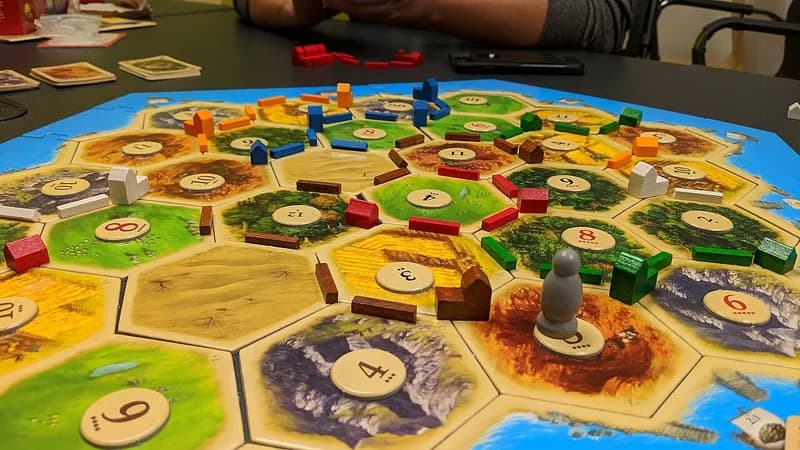
- Photo: Yonghokim, CC BY-SA 4.0, via Wikimedia Commons (resized) (CC BY-SA 4.0, Yonghokim): A Catan board in the middle of a game, roads and settlements in five colors, the robber in the desert
- Box art: CATAN GmbH / CATAN Studio (publisher image (catan.com), shown to identify the product): Box of Catan, 6th edition (2025): a red sky and a low sun over farmland, a shepherd and sheep in front